

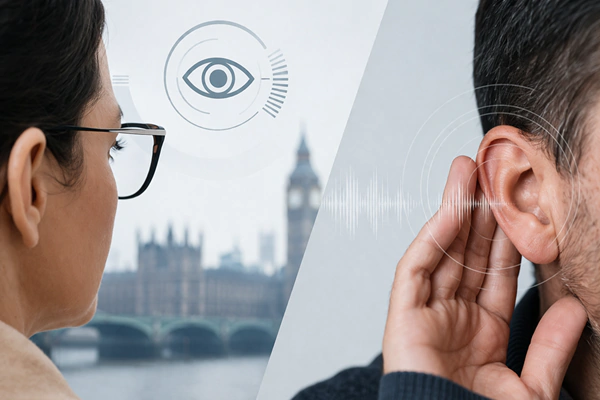
Losing vision or hearing changes how people move through the world. In a city like London, where daily life relies on awareness, communication, and constant movement, that change can be immediate and disorientating. Many people describe it as losing a sense they depended on without ever thinking about it.
Sight or hearing loss does not always happen suddenly. In some cases, it develops after an accident or medical error. In others, it worsens over time following delayed treatment or workplace exposure. What these cases have in common is that the impact often goes far beyond the initial diagnosis.
How loss of vision or hearing occurs in London
Vision and hearing loss can arise in a range of situations across London. Road traffic accidents, workplace incidents, and assaults can all result in head or sensory damage. Even where the injury does not appear severe at first, the effects can become clearer over time.
Medical negligence is another significant cause. Delayed diagnosis of eye conditions, failures in monitoring infections, surgical errors, or problems during treatment can all lead to permanent damage. Hearing loss may also result from exposure to excessive noise at work, particularly where proper protection or risk assessments were not in place.
In some cases, the loss is partial rather than total. Reduced vision in one eye or hearing loss in one ear can still have a major effect on balance, awareness, and confidence, particularly in busy environments.
The impact on independence and daily life
Vision and hearing play a central role in everyday activities. When one of these senses is impaired, tasks that once felt automatic can become challenging.
People with sight loss may struggle with reading signs, navigating unfamiliar areas, or judging distance. Crowded pavements, road crossings, and public transport can feel overwhelming. Hearing loss can affect conversations, awareness of traffic, and the ability to respond to warnings or alarms.
These changes often affect independence. Some people avoid going out alone or feel anxious in busy places. Others find that work tasks become more difficult, particularly where communication or visual accuracy is essential.
Effects on employment and communication
Loss of vision or hearing frequently affects work. Adjustments may be necessary to continue safely and effectively, depending on the role. Some people require assistive technology, modified duties, or changes to their working environment.
Subtle changes can also impact communication. Hearing loss may make meetings exhausting, especially where background noise is present. Vision loss can slow down tasks that rely on screens, documents, or fine detail.
These challenges can be frustrating, particularly where others underestimate the impact because the disability is not immediately visible.
Adaptations and support needs
Many people with sensory loss rely on adaptations to maintain independence. These may include visual aids, hearing devices, specialist software, or changes to the home or workplace.
Training and rehabilitation can also play an important role. Learning new ways to navigate environments or communicate effectively takes time and support. In some cases, ongoing assistance is needed to manage daily activities safely.
The need for adaptations is often long-term. Technology may change, but equipment and support usually require regular review and replacement.
Medical evidence and diagnosis challenges
Claims involving loss of vision or hearing depend heavily on medical evidence. Determining the cause and timing of the loss, as well as its avoidability, can often be a complex process.
Specialist assessments are usually required to measure the extent of the impairment and its likely progression. In cases involving delayed diagnosis or treatment, expert opinion helps explain whether earlier intervention would have made a difference.
Because sensory loss is not always obvious, clear evidence is essential to demonstrate its real impact on daily life and future needs.
Compensation considerations in sensory loss claims
Compensation in loss of vision or hearing claims reflects both the injury itself and the wider consequences. This may include medical treatment, rehabilitation, and the cost of assistive equipment.
Where sensory loss affects employment, compensation can also account for loss of earnings or reduced future earning capacity. Compensation may include adjustments to the home or workplace, particularly if they impact independence or safety.
The long-term nature of sensory loss means future needs must be considered carefully. Underestimating these needs can leave people without adequate support later on.
Why these claims require a tailored approach
Sensory loss claims are highly individual. The same level of impairment can affect two people very differently depending on their work, lifestyle, and personal circumstances.
A tailored approach helps ensure that the claim reflects the person’s real experience rather than assumptions based on medical labels alone. This includes understanding how the loss affects confidence, communication, and independence in a city environment.
How Marley Solicitors support vision and hearing loss claims
Marley Solicitors represent clients in London who have experienced loss of vision or hearing due to accidents or medical negligence. Their approach focuses on understanding how the impairment affects everyday life, work, and future independence.
By working with specialist medical and rehabilitation experts, they aim to build claims that reflect long-term needs rather than short-term impact alone. Careful preparation helps ensure that the full consequences of sensory loss are properly considered.
Living with sensory loss in a busy city
Adjusting to vision or hearing loss takes time. Many individuals recount a phase of experimentation as they discover the most effective support and adaptations for their needs.
Seeking advice can help provide clarity about options and next steps. Understanding where responsibility lies and what support may be available makes it easier to focus on adapting and moving forward, rather than struggling with uncertainty.