

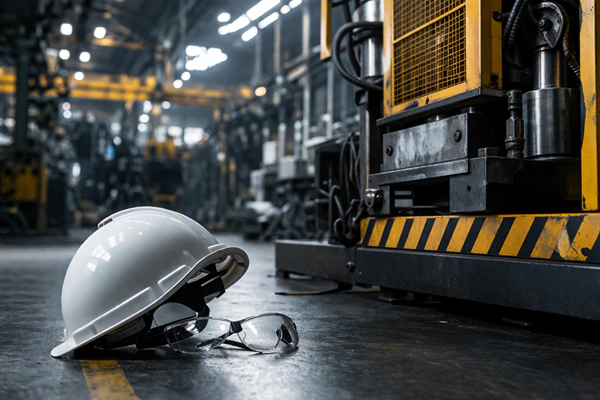
Machinery accidents usually have a cause. Most often, a minor issue arises long before any injuries occur. A guard was removed to save time, maintenance was skipped because the machine “usually works fine”, training was rushed because a shift needed covering, etc. In London workplaces, where pace and pressure are constant, these small compromises often sit unnoticed until they combine.
When machinery fails, the consequences are immediate and severe. Not only do workers face physical injuries, but they also grapple with the possibility of preventable outcomes.
The chain that leads to a machinery accident
Unlike many other workplace injuries, machinery accidents tend to follow a pattern. They are rarely caused by one isolated decision.
A typical chain begins with equipment that is poorly maintained or not properly inspected. This is followed by inadequate training, unclear instructions, or pressure to keep production moving. Safety features may be disabled, or workers may be expected to operate machinery they are unfamiliar with.
When something finally goes wrong, the injury is sudden, but the conditions that allowed it to happen have often existed for weeks, months, or even years.
Where machinery accidents occur in London
Machinery and equipment injuries occur across a wide range of London workplaces. Factories, warehouses, construction sites, and recycling facilities are common settings, but they are not the only ones.
Machinery in commercial kitchens, workshops, printing facilities, and logistics hubs can cause serious harm if it malfunctions or misuses. In some environments, workers move between different machines during a single shift, increasing the risk of error where training or supervision is lacking.
Temporary workers and agency staff can be particularly vulnerable, especially where induction processes are minimal or inconsistent.
The injuries machinery accidents often cause
Machinery accidents are often life-changing. Crush injuries, amputations, fractures, and severe lacerations are common, particularly where heavy or moving parts are involved. In some cases, workers are pulled into machinery or struck by equipment that fails unexpectedly.
Even where injuries are not catastrophic, recovery can be long and uncertain. Damage to hands, arms, or legs frequently affects a person’s ability to work, particularly in manual roles. Pain, reduced function, and psychological effects are common after serious workplace accidents.
These injuries are rarely easy to “work around”, they change what a person can safely do.
Why employer responsibility is central in machinery claims
Machinery and equipment accidents are closely linked to employer responsibility. Employers are expected to ensure that machinery is safe, properly maintained, and suitable for the task being carried out.
This includes providing adequate training, clear instructions, and appropriate supervision. Safety guards and emergency stop mechanisms should be in place and functioning, not removed or ignored for convenience.
Where employers fail to meet these duties, and a worker is injured as a result, liability may arise. These cases often turn on what should reasonably have been done to prevent the accident.
Evidence that matters in machinery accident cases
Evidence in machinery accident claims often goes beyond witness statements and medical records. The condition of the equipment itself can be critical.
Maintenance logs, inspection records, training documents, and risk assessments all help build a picture of how the workplace was being managed. Pictures of machines, guards, or warning signs can also be useful.
In some cases, expert evidence is needed to explain how a machine should have been operated and whether safety standards were breached. This helps move the focus away from individual blame and onto systemic failure.
The impact on work and future employment
Machinery injuries frequently affect a person’s ability to return to the same type of work. Manual roles may no longer be possible or may require significant adjustment.
Some people are forced to retrain or accept lower-paid work because of physical limitations. Others experience long periods away from employment while recovering or undergoing further treatment.
These changes have long-term financial consequences, particularly where the injury occurs mid-career. Understanding this impact is an essential part of assessing these claims.
Compensation considerations in machinery accident claims
Compensation in machinery accident claims reflects both the injury and its wider consequences. This may include medical treatment, rehabilitation, and ongoing therapy.
Loss of earnings often plays a significant role, especially when it reduces future earning capacity. In more serious cases, compensation may also account for long-term care, support, or adaptations needed to maintain independence.
Each case depends on its specific facts, including the severity of the injury and how it affects the person’s ability to work and live independently.
Why these claims require careful investigation
Machinery accident claims often involve multiple layers of responsibility. Equipment suppliers, maintenance contractors, and employers may all play a role.
A rushed or superficial investigation risks missing where the real failure occurred. Careful examination of systems, training, and maintenance is essential to establish what went wrong and whether the accident could have been prevented.
This is especially important in workplaces where unsafe practices have become normalised over time.
How Marley Solicitors support machinery accident claims
Marley Solicitors represent workers in London who have been injured in machinery and equipment accidents. Their approach focuses on identifying failures in safety systems, training, and maintenance, rather than placing blame solely on the injured worker.
By reviewing workplace records and obtaining appropriate expert evidence, they aim to build claims that reflect how and why the accident occurred and the long-term impact on the individual’s life and work.
Deciding what to do after a machinery accident
After a machinery accident, many workers feel unsure about speaking up, particularly where workplace culture discourages complaints. People may accuse others of causing the incident, despite the absence of safety measures.
Seeking advice can help clarify whether proper standards were followed and whether the injury could have been avoided. For many people, that clarity is an important step toward recovery and future security.