

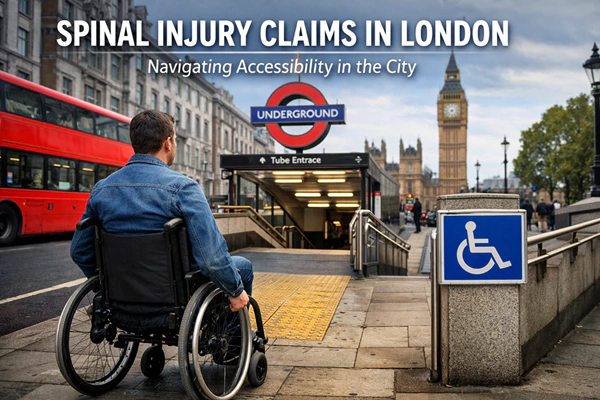
A spinal injury does not just affect the body; it changes how someone moves through the city. In London, that change is immediate. Pavements feel narrower, steps feel steeper, buses and trains become obstacles rather than conveniences, and places that once felt ordinary suddenly require planning.
For many people, the injury itself is only the beginning. What follows is a constant negotiation with space, access, and independence, often in an environment that was never designed with spinal injuries in mind.
What a spinal injury changes day to day
Life after a spinal injury is shaped by movement, or the lack of it. Tasks that once happened without thought, like getting to work, shopping, and visiting friends, now involve calculation and adaptation.
Independence is often affected in ways that are difficult to explain to others. Everyday life involves routine changes, energy rationing, and reliance on equipment or support. Even where some mobility remains, confidence can be shaken, particularly in busy or unpredictable settings.
These changes are not abstract. They influence where someone can go, how long they can stay there, and how much control they feel they still have over their life.
How spinal injuries typically occur in London
Spinal injuries arise in a range of situations across London. Road traffic collisions remain a common cause, particularly high-impact accidents involving cars, motorbikes, cyclists, or pedestrians. Workplace incidents also feature heavily, especially falls from height or accidents involving heavy equipment.
Serious falls, whether in public spaces or poorly maintained buildings, can also result in spinal damage. While the circumstances vary, the outcome is often similar, a sudden loss of mobility or function that reshapes daily living.
Why outcomes vary so widely
Spinal injuries exist on a broad spectrum. Some people retain movement or sensation; others experience partial or complete paralysis. Two people may both be told they have a spinal injury, yet live very different lives as a result.
The level of injury, the extent of damage, and how quickly treatment is provided all influence the outcome. Rehabilitation can improve function, but it does not always restore what was lost. This uncertainty is one of the hardest aspects to live with; progress is possible, but limits often remain.
Equipment, adaptations, and practical reality
Adaptation becomes central after a spinal injury. Equipment and changes to the home or vehicle are not luxuries; they are often essential for independence.
Long-term needs may include:
- Mobility aids or wheelchairs, often requiring regular replacement
- Home adaptations such as ramps, widened doorways, or accessible bathrooms
- Vehicle adaptations to allow safe travel
- On-going physiotherapy or specialist support
These needs evolve over time, particularly as equipment wears out or circumstances change.
How London’s environment amplifies the impact of a spinal injury
Living with a spinal injury in London brings challenges that are easy to underestimate until they are lived day to day. The city’s density, pace, and infrastructure often magnify the practical effects of reduced mobility.
People commonly encounter difficulties with:
- Uneven pavements, narrow walkways, and poorly maintained surfaces
- Stations without step-free access or lifts that are frequently out of service
- Crowded public transport, where space and priority access are limited
- Older buildings with stairs, heavy doors, or inaccessible layouts
- Workplaces that were never designed with long-term mobility needs in mind
These factors do not cause the injury, but they shape how restrictive it becomes. What might be manageable in a more accessible environment can feel overwhelming in a city that requires constant movement and adaptation.
Work, income, and long-term independence
Spinal injuries frequently affect employment. Some people are unable to return to their previous role; others need significant adjustments or retraining. Physical access, fatigue, and pain all influence what is realistically possible.
Even when an individual resumes their work, their earning capacity might decrease. Career progression can be affected, particularly in roles that relied on physical activity or long hours. These financial implications are long-term and require careful consideration, not short-term assumptions.
How spinal injury claims are assessed
Spinal injury claims are assessed with a strong focus on permanence and future needs, rather than short-term recovery. This makes them different from many other injury claims.
Assessment usually involves:
- Understanding how mobility and independence changed after the injury
- Identifying what support, equipment, or care is now required
- Examining whether earlier action could have reduced the severity of the outcome
Medical evidence plays a central role, but so does practical evidence about how the injury affects everyday life.
Why spinal injury claims are treated differently
Unlike injuries that may improve significantly over time, spinal injuries often involve lasting change. Planning for the future becomes essential, particularly where mobility, care, or accommodation needs are on-going.
This long-term perspective is critical. Underestimating future needs can leave people without adequate support years later, long after a claim has concluded. Careful, forward-looking assessment is therefore a defining feature of spinal injury cases.
How Marley Solicitors support spinal injury claims
Marley Solicitors represent clients in London who are living with the long-term effects of spinal injuries. Their approach focuses on understanding how the injury affects independence, mobility, and future planning, rather than treating it as a single event.
By working with medical, rehabilitation, and care experts, they aim to build claims that reflect real-life needs over time. The emphasis is on clarity, preparation, and ensuring future requirements are properly accounted for.
Looking ahead after a spinal injury
A spinal injury brings uncertainty, but it also brings a need for structure and planning. Adaptation is not just physical, it is practical and financial as well.
Seeking advice can help clarify what support may be available and whether the injury could have been made less severe with different action. For many people, that understanding is an important step in regaining control and planning for the future in a changed environment.